When You Are Trying to Figure Her Out but Shes a Triple Moon Goddess Funny Saying
Beyond Female person Role Models: The Triple Goddess as Nature July nineteen, 2015 John Halstead
The Development of the Androcentric Triple Goddess
Probably no motif is more than ubiquitous in the Neo-Pagan culture than that of the Triple Goddess in her threefold aspects: Maiden, Mother, and Crone. While there are some historical antecedents for the Neo-Pagan Triple Goddess, she is really a 20th century cosmos of the writer and poet, Robert Graves. Graves' conception of the Triple Goddess evolved over several years. 1 of the before incarnations, in his book The Gilded Fleece, took the form of "Maiden, Nymph, and Mother" which corresponded to the "New Moon, Full Moon, and Old Moon". ("Nymph" is the Greek word for bride.) Absent from this description of the Triple Goddess was the dark "phase" of the Goddess, the "Crone". In his adjacent book, King Jesus Graves described her equally the triform goddess of birth, dearest, and decease, and associated her with the figures of mother, consort, and witch.
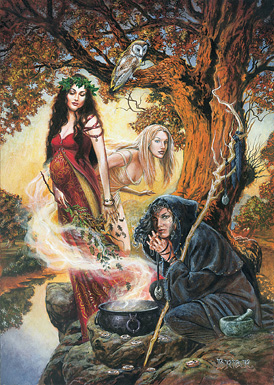 Many Neo-Pagans will be familiar with Graves' next book, The White Goddess, as the origin of the Maiden-Female parent-Crone trinity. But those who have non actually read the book may non know that Goddess actually describes the Triple Goddess in 3 different means in the book:
- Mother-Bride-Layer-out
- Maiden-Nymph-Hag
- Maiden-Mother-Crone
And Graves did not fifty-fifty limit himself to the iii aspects, but described a Quintuple Goddess, whose stations were: "Birth, Initiation, Consummation, Quiet and Death".
While the Maiden-Female parent-Crone trinity ultimately became the near pop form of the Triple Goddess amongst Neo-Pagans, information technology was really the Mother-Helpmate-Layer-out which primarily concerned Graves in The White Goddess. This is the version of the Triple Goddess as seen from the perspective of her male counterpart. The trinity begins with the Female parent, because that is how men first come across women. More than the Triple Goddess herself, Graves was concerned with the interaction of the Triple Goddess with her male person counterpart. For each of the aspects of the Triple Goddess, there is a respective aspect of the homo or the god who is her son (corresponding to Mother), lover/espoused (respective to Nymph/Bride), and victim/sacrifice (corresponding to Crone/Layer-out). As Mother, the Goddess gives birth to the god of the yr. As Bride, the Goddess takes the god as her lover, and in her womb he sows the seeds of his own rebirth. As "Layer-out" or Slayer, the Goddess inspires the god's twin-rival to slay him, his expiry condign a sacrifice to the goddess, a cede which fertilizes the earth and makes possible his subsequent rebirth.
The Limitations of the Feminist Triple Goddess
 The image of the Triple Goddess was seized upon by feminist Neo-Pagans and Witches in the 1970's equally a new vision of femininity. The Goddess in her multiple forms was seen as a revaluation of aspects of femininity which have been denigrated historically, including menstruation (Maiden), childbirth (Mother), sexuality (Lover/Bride), and menopause (Crone). Most significant was the feminist reclamation of the word "Crone" to mean a wise woman. There is a sure irony in this, since Graves' vision of the Triple Goddess was at all not feminist, but androcentric and even somewhat misogynistic.
The Maiden-Mother-Crone trinity later came nether assault past feminists who criticized its over-accent on women'south fertility and sexual desirability to men. They pointed out that not all women become (or even want to become) mothers. In improver, there are feminine archetypes which are not encompassed in the Maiden-Mother-Crone trinity, like the Amazon or the Priestess. And women may manifest different "aspects" of the Goddess at any betoken in lives, and that attribute may or may not correspond to their chronological age or the state of their wombs.
The Triple Goddess of Nature
Rather than seeing the Triple Goddess primarily a part model for women, we might rather understand her every bit a form of the Great Goddess (sometimes just called "Goddess") who many Neo-Pagans identify with Nature or the Universe. If the Goddess is Nature, and so the idea that the Goddess has a life cycle reminds us that alter is a central quality of Nature. We see this in the both phase of the moon and the seasons, which Robert Graves associated with the stages of the female life wheel. As well, the suggestion that the Triple Goddess ages, but does not dice, and that she is perpetually renewed, reminds u.s.a. that change in Nature is often cyclical, rather than linear. Equally Paul Reid-Bowen explains in Goddess as Nature: Towards a Philosophical Theaology: "Thus, the triplicity of the Triple Goddess evokes a notion of diverseness and difference within nature, while the unity of the Triple Goddess symbolizes the Sacred Whole, the unity of nature, expressed in the wheel of nascence-growth-decay-regeneration."
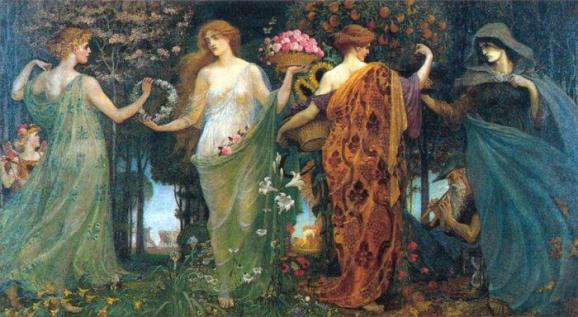
Many Neo-Pagans have a tendency to focus on the triplicate nature of the Triple Goddess. But, if the Goddess is Nature, then it is not the number of her aspects that is near significant. She may have four or five aspects, as Robert Graves suggested, or fifty-fifty more. What is unique about the Triple Goddess then is the human relationship among her aspects. That relationship suggests movement amid the different aspects, specifically, a cycle that returns upon itself. The significance of the Triple Goddess then is to exist found, not the specific aspects of Maiden-Mother-Crone, or even the number three, but in the perpetual cyclical movement amidst the aspects, whatever their number and nevertheless they are named.
Paul Reid-Bowen explores this understanding of the Triple Goddess:
"[T]he iii aspects of the Goddess, Maiden-Mother-Crone, are theaologically understood not but to exist pre- and mail-patriarchal models of female identity, only also a dynamic whole: 3 aspects of a unity. And, while extensive thealogical energy has been invested into charting the character and pregnant of each of these different aspects of the Triple Goddess, I am concerned with how the model functions as a dynamic whole. Notably, the model of the Triple Goddess is understood to take metaphysical significance because it is thealogically understood to illuminate broader patterns occurring within the whole construed every bit nature. The Triple Goddess emphasizes not merely changes, cycles and transitions in terms of a female life-blueprint, simply also with respect to cosmology and ecology (lunar and seasonal cycles) and existential and metaphysical processes and states (birth/emergency, growth/generation, decay/degeneration and rebirth/regeneration)."
In this view, the Triple Goddess is not a office model for women. Rather, she represents Nature. And the relationship between the Triple Goddess and us reflects our relationship with Nature. To us, she is Mother, Lover, and ultimately, Slayer. We are her children, all of us, male and female. And nosotros are, all of u.s.a., likewise her lovers and victims.
Mother
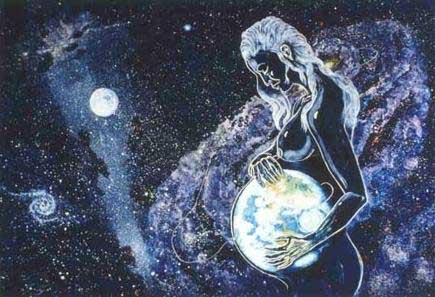 The image of the Goddess as Mother reminds u.s.a. that we were not created by Nature, in the sense of an artifice fashioned past the Abrahamic creator. Rather we grew up as part of Nature, organically. The Greek historian Plutarch recognized this truth (although he used masculine language instead of feminine language, which has been inverse beneath):
"The piece of work of a maker — as of a builder, a weaver, a musical-instrument maker, or a bronze — is altogether singled-out and split from its author; but the principle and power of the procreator is implanted in the progeny, and contains his nature, the progeny existence a slice pulled off the procreator. Since therefore the world is neither like a slice of potter'due south work nor joiner'southward work, but there is a swell share of life and divinity in it, which God from [her]cocky communicated to and mixed with matter, God may properly exist called [Mother] of the globe — since it has life in it."
Nor are we separate from Nature fifty-fifty now. In that sense, we are even so in the womb of the Goddess.
Lover
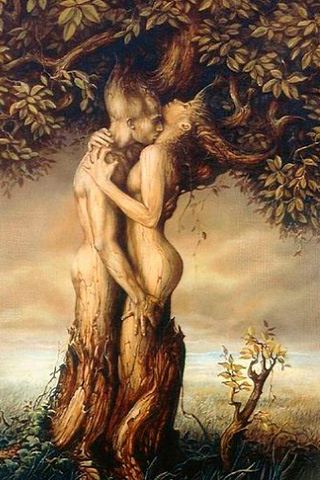 The image of the Goddess equally Lover reminds the states that we can find a degree of (re-)union with the Nature while yet living. We experience this as we remember our essential oneness with Nature, something which we humans accept a unique power to get alienated from. This reconnection is, I think, one of the functions of Neo-Pagan ritual. But even something equally simple every bit taking a walk in the woods has the potential to dissolve the existential boundary between our sense of self and the earth. As fellow Patheos blogger, Karen Clark, explains:
"While our collective humanity has lost sight of the ways of the dark-green world, pagans hunger to touch and be touched by the powers and splendor of nature. And in this sensual, embodied exchange, we awaken to the living globe.
"Hang out in your favorite light-green space with your senses on high. Modulate to your commutation of breath with the trees: their light-green jiff of oxygen with your red breath of carbon dioxide. Open up your flat palms toward any wild affair catches your fancy and sense the tingling meeting of your energies. Peer into the microcosm of a rotting log, with its teeming collective of interdependent inhabitants.
"The Earth is alive. One spider web of life connects u.s.a. all, breath to breath, and essence to essence. What your heed has forgotten, your body remembers."
Reading this makes me recollect of reconnection with nature as a kind of lovemaking. (See Trebbe Johnson's The World is a Waiting Lover .) Harry "Dion" Byngham (of the Order of Woodcraft Chivalry fame) expresses this thought poetically:
"life springs out of the star-tissued womb of Nature as the virile son of the All-Female parent. Life seeks reunion or religion with Nature, his female parent, not still, past falling back into her arms and surrendering again to some primordial slumber and dream, merely by striving away from and with her, searching her, playing with her, dancing earlier her, wooing her, overcoming her, until she, who is eternally young as well as eternally old, responds similar a maiden to his life and will and power, and, in the transfiguring ecstasy of union a new cosmic consciousness is conceived."
In spite of the patriarchal and dominating language in this quote, I still like the imagery of striving, searching, playing, dancing, and wooing to express our relationship with Nature.
Slayer
 Finally, the Goddess as Slayer reminds us that every experience has an end and no joy lasts forever. Only likewise that every sacrifice promises new life, and cipher dies in vain. There is no true end, only transformation. The Triple Goddess reminds u.s. that, throughout all of these successive births and decease, at that place is something which transcends it all, the eternal bike itself. Every bit Jules Cashford and Anne Baring explicate in The Myth of the Goddess: Evolution of an Prototype:
"The great myth of the Bronze Age is structured upon the distinction betwixt the 'whole', personified as the Great Mother Goddess, and 'the part', personified every bit her son-lover or her daughter. […] the Goddess may exist understood as the eternal cycle of the whole: the unity of life and death as a single process. The young goddess or god is her mortal form in time, which, every bit manifested life […] is field of study to a cyclical process of birth, flowering, disuse, expiry and rebirth."
"[…] the son-lover [or daughter] must accept death – as the prototype of incarnate beingness that falls back, similar the seed, into the source – while the goddess, hither the continuous principle of life, endures to bring along new forms from the inexhaustible store."
Knowing this allows us to accept the fact of our annihilation, knowing that there is something greater which transcends our private selves. And in and so doing, we get free to truly alive. As Joseph Campbell explains, this is the office of certain religious rituals:
"When the will of the individual to his ain immortality has been extinguished—as it is in rites such equally these—through an constructive realization of the immortality of being itself and of its play through all things, he is united with that being, in experience, in a stunning crisis of release from the psychology of guilt and mortality."
This cosmic vision of the Triple Goddess avoids the sexism that results from treating the aspects of the Goddess as office models for women, at the same time it offers insight into the mystery of the relationship between ourselves — whatever our gender — and Nature.
Source: https://www.patheos.com/blogs/allergicpagan/2015/07/19/beyond-female-role-models-the-triple-goddess-as-nature/
0 Response to "When You Are Trying to Figure Her Out but Shes a Triple Moon Goddess Funny Saying"
Post a Comment