Hey authors worried about being tracked after you do your weird searches. May I present the browser I use? No more getting targeted ads because you wanted to know the symptoms of a specific disease.
Firefox.
It really works.
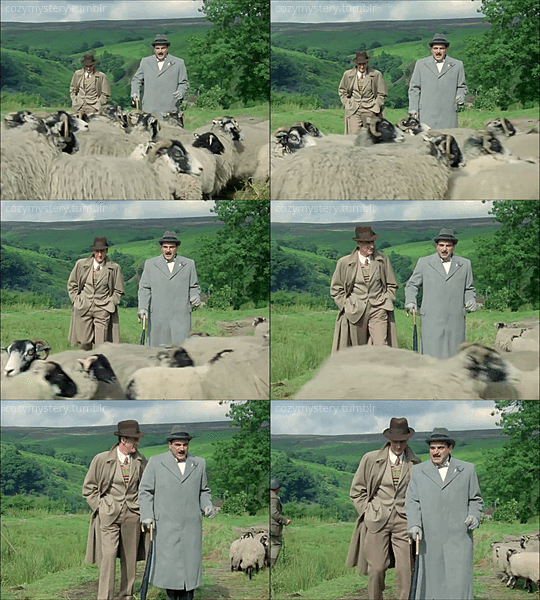
During World War One, Captain Hastings is visiting friends in the British countryside when the matriarch of the family suddenly dies. Suspicion immediately falls upon the husband home everyone dislikes but there's a mystery to this. Thankfully, the great detective, Hercule Poirot, Is living nearby. At the request of the family and his dear Hastings, Poirot is on the case.
Originally posted by perfides-subjekt
I've always loved the Hercule Poirot books. I find the little Belgian detective absolutely delightful especially in his kindness and childlike joy in making people happy. He's got all of the intelligence of Sherlock Holmes but possesses the kindness of Dr. Watson. Yes, he's a bit peculiar. He's got his foibles and prejudices. But Oh my, is seeing him in his first appearance is fun.
This is a classic Agatha Christie novel in every sense. It's set in the British countryside. At the manor house. With a small cast of characters all of whom have the means more of an opportunity to commit the crime. The foreshadowing is there and it is on point.
Originally posted by cozymystery
And then there's the typical Agatha Christie twist. And it's a twist because the clues are in there, but the way that they presented the read can end up discounting them. Much like the characters in the book discount the clues when they are presented them. This is what makes the twist effective. The reader has all of the information. The reader knows everything that Poirot knows. And still Christie can surprise you. It's lovely.
Originally posted by poirott
As stated before, this is the first published Hercule Poirot mystery. It was written in 1916 at the height of World War I. Which means that cultural and societal conventions of the time are in play. This includes things like casual racism and use of racist language regarding people of color including those of Roma and African descent. It also includes massive amounts of xenophobia which Britain is still well known for. And there's also casual antisemitism because again this is the 1910s, there's a reason Hitler was allowed to rise to power and why countries refused Jewish refugees and that reason is called Antisemitism. It's important to know this going in. The words and the sentiments expressed in this novel are wrong, and they were wrong then. But they are still products of their time. And erasing them or refusing to allow people to read them is trying to erase that history. And our present is build upon this very real history. At the same time it's important to have this context.
Originally posted by poirott
As a historian, this book is a fascinating trip into the mindset of someone who lived through World War I and was writing about it contemporaneously. Yes, there is problematic language used, there always is in primary resources. And this can be considered a primary resource of life in the 1910s. Even thought it is fiction.
The book is also a fun mystery with some really great characters. Which is why I'm going to get this five stars with the caveat that readers understand that they are reading a novel that is a product of its time.
Five stars.
If this is your jam, you can get it here.
It's also in the public domain, which means IT'S FREE. (Project Gutenberg Link)
If you like these kind of honest reviews, please consider supporting us here!
septembercfawkes:
Advice from editing: The more words you use to describe something, the more important the audience will think it is. So maybe … save that for the things that actually are most important 😅
Allura in the morning. She's trying to attack the roses. The same rose that our icon came from.
obaewankenope:
obaewankenope:
obaewankenope:
fuck google docs so fucking much
i've just lost hundreds of docs and pdfs and i'm beyond pissed right now
they're all permanently gone
actually they're notholy shit
okay so, gonna tell ya'll something awesome rn
google drive is a mess sometimes with its storage things and if you're unlucky it might delete some of your files and you won't realise until it's well past the point where they won't be in 'trash' anymore and you're fucked
all is not lost however!
if you're on drive via browser, hit the little ? in a circle next to the settings cog and select "help"
search for "file recovery"
it'll show you the ways to try and recover your files on pc, android, and mac etc
these don't matter
you need to scroll down to the bottom and just hit the "contact us"
you'll be logged out automatically
log back in
click the little box to give google permission to attempt to restore your files for that account
click "submit"
give them some time to work but it's an automatic process
i've got most of my files back in less than 10 minutes
all is not lost! rejoice!
I'm gonna reblog this again bc wow but was it helpful to learn!
When you think of Ancient Rome, what often comes to mind is debauchery coupled with almost puritanical morals. Orgies. Vestal Virgins. Nero and Caligula. You know, the juicy stuff that peppered both HBO and PBS.
But what was the truth? Is it closer to the sex fueled fantasies of 1970s x-rated films and pearl clutching Christian saints? Or is it the dry and politics heavy shenanigans of I, Claudius.
The truth is amusingly revealed in this really fun historical quick-read by LJ Trafford.
Originally posted by blondebrainpower
First off, I need to level with you. I got this book because of the cover. This is one of my favorite paintings in the history of ever (Lorenzo Lotto's Venus and Cupid) and every time I go to the MET in NYC I have to spend some time communing with it. It's just that bonkers and fun and faboo. (I have a thing for odd Renaissance and Medieval art.)
So I should have been clued in that by selecting this picture the book itself is also just as fun and whimsical as the painting, and like the painting there is a whole lot more going on when you scratch the surface. Using primary sources of the day, Trafford explains that like many cultures and civilizations that there was nuance and hypocrisy when it came to Ancient Roman views on sex and sexuality. And that like many ancient (and let's face it, modern) civilizations that the expectations differed between classes and genders.
Originally posted by take2intotheshower
The book is written in an amazingly readable format, and I often found myself laughing out loud at several turns of phrase. I managed to read this book while undergoing treatment for two different kinds of cancer and it was just the distraction I needed. The author was a tour guide in a previous life and it shows. The way the history and primary resources are presented are geared for a lay audience who wants to learn more after binging HBO's Rome or Masterpiece Theater's I, Claudius.
Readers do need to be aware that there is a lot of swear words, but this shouldn't be surprising considering the graffiti that has survived from the period. It can be shocking if you think of Rome as a bunch of stuffy senators and pearl-clutching early Christians. But Rome is/was a very earthy and messy place (often literally) and this book doesn't shy away from that.
I honestly enjoyed it.
Five Stars.
If this is your jam, you can get it here.
If you like these kind of honest reviews, please consider supporting us here!
I received an ARC via NetGalley.
**Review delayed due to cancer.
cracked.com 22 Rules of Storytelling Pixar Follows in their Movies This is their recipe for success (and heart-tugging tales).
You've probably seen this list of Pixar's rules of storytelling, but this article nicely illustrates how they follow those rules and what happens when they don't.
It's a good read for writers and narrative storytellers of all sorts.
fixyourwritinghabits:
fixyourwritinghabits:
Let's Talk About Comp Titles
It's time to talk about the very worst part of writing. No, not revising, no not synopsis - comp titles, the worst part is comp titles. A comparison "comp" title is a published work that can be compared to your novel in several ways - similar in tone, topic matter, tropes, etc.
Why do you need comp titles?
If you are traditionally publishing, comp titles will be important at every stage of the journey. First, most agents prefer at least two comp titles in queries. When you get to the stage of selling the book, the editor will also want comp titles to help pitch it to their team. You'll want comp titles when marketing the book to pull in readers who want to find more of what they want to read.
Even if you're self-publishing, comp titles are very useful, so it's a good idea to keep them in mind. Comp titles are a pretty important part of publishing a book.
What can you use for comp titles?
Comp titles, unfortunately, have some pretty rigid set of rules. The general rule of thumb is:
Recently published (within the last 2-3 years is ideal)
Same genre and marketing category (YA books for YA, sci-fi books for sci-fi, etc)
Same format (comp books for books, graphic novels for graphic novels, etc)
All of these rules are pretty important, and also very easy to bungle. It's very tempting to cite an older book for inspiration, because it probably was. It's also tempting to pick a movie or TV series, because it would be easily recognizable.
However, you have to remember that comp titles are for marketing purposes. You want to use them to prove you're familiar with the audience you're writing for as well as appeal to readers who are specifically looking for books (not movies). So while comparing Our Flag Means Death to your book for a quick twitter pitch is fine, you'll want to stick to the rules for querying.
How do you find comp titles? Part One
Ah, the hardest part. We're told to write something original and special to us, and then told to find things that are Just Like It in order to pitch it to someone. Not only does that sting a little, it goes against most of the writing process, so comp titles tend to be difficult to do.
First, take your book and try to boil it down to basic themes. You'll want to lay out:
Genre and sub-genre (Romance and rom-com, fantasy and contemporary fantasy, etc)
Common elements (Court drama? Sword-fighting? Dragon fantasy versus faerie fantasy? Types of magic?)
Audience (Middle Grade? YA? Someone who buys books at the airport, or is hunting for the next massive sci-fi series to follow? Cosy mystery readers and thriller mystery readers might overlap, but you'll want to pin down the biggest group of people who would read your work).
Tropes (found family, enemies to lovers, subverted chosen one, etc. Embrace those AO3 tags, my friend. They will help you seek out the right titles)
Authors you're similar too (harder, but if you know you fit into a certain style, embrace it)
How do you find comp titles? Part Two
The actual hard part - no matter how well-read you are, finding comparable books is actually hard. Here's a few methods, none of them perfect, to try to get started.
Amazon's "customers also bought" recommendations - (obligatory pause for boos) But actually pretty helpful if you've found one book and need similar.
EBSCO Novelist - A search engine for libraries, usually available through your local library if you're in the US. If you can't find it on their website, ask your librarian - or see if a buddy from another county can loan you their card number for access.
Goodreads Lists - There's a lot of bad about Goodreads, but one thing the userbase is great at is creating lists of books by genre, market, and publishing year - and can help you see how they're described.
Monthly New Releases - Multiple cites track new releases by genre, and it's a good idea to get on top of the market you want to sell in as soon as possible.
BookBrowse - Extremely thorough book recommendation site, just don't get lost. It's very tempting to get lost.
Literature Map - Suggests similar authors based on your input.
Writer's Digest, The Writer, Poets&Writers - and any other current magazine. They often interview newly published writers and have a good thumb on what's being published.
Your local librarian - Seriously, someone at your library is working very hard to keep on top of new releases, and they would love to help you find what you need. The only librarians that eat people are in Night Vale, so you should be fine. Unless you live in Night Vale, which in that case, my condolences to your interns.
Wrap-Up Questions
Are you sure I can't comp a movie/TV series/manga? It's highly recommended to only comp books if you are trying to sell a book (in a query to an agent, specifically), but hey, I can't tell you what to do. You might have the perfect pitch, and agents are fickle beasts. Whatever works, works.
What if I really want to comp [insert very popular older series here]? The problem with comping Super Popular Thing Everyone Knows is that your book is obviously not Super Popular Thing, so it's not useful to gauge the tone of your work. This isn't true for all things - Sherlock Holmes in the22nd century Space works, but avoid Game of Thrones. You don't want to rouse the r/freefolk crowd, I promise you.
Is there anything I should not comp? Every single video game comp I've seen has bombed hard. They just don't fly, probably because people who work in publishing don't have time to play video games.
What do I tell my friend who thinks their book is too unique to comp? There's no getting through to them, you just have to let them find that out the hard way. Comp titles are for marketing, and you'll need to market your book. It'll get easier. I think.
Should I read my comp titles? Yes and for the love of nachos, if you don't have time to read it, make sure you have a thorough understanding of the plot. The last thing you want is to query an agent who has a hard no against sexual assault scenes and whoops, one of your comp titles has a notorious sexual assault scene. Spare yourself the grief and make sure your comps are appropriate to your work.
Some quick extra notes:
The comp title doesn't have to be very similar to what you wrote, just something to convey who your buying audience would be. That's why tropes can help you. From "enemies to lovers" to "queer YA contemporary," these labels can help you tell an agent/editor where your general reader audience would be.
Comps don't have to be perfect. An agent likely isn't judging your query by its comps alone and usually will help you figure them out when it comes to pitching to an editor.
The "only comp books for books" rule is for dealing within publishing. If you're pitching directly to readers (via Twitter, newsletters, vaguely threatening notes left on car windows), whatever conveys the feel you want goes.
Be clear about why you're citing certain comp titles, especially if they seem to conflict. "The River Has Teeth meets Act Cool" clashes in both setting and genre. "A sapphic horror tale along the lines of A River Has Teeth set in a fraught acting school enviroment of the likes of Act Cool" (this still doesn't quite work, but I hope you get what I mean.)
perpetual-stories:
Story Structures for your Next WIP
hello, hello. this post will be mostly for my notes. this is something I need in to be reminded of for my business, but it can also be very useful and beneficial for you guys as well.
everything in life has structure and storytelling is no different, so let's dive right in :)
First off let's just review what a story structure is :
a story is the backbone of the story, the skeleton if you will. It hold the entire story together.
the structure in which you choose your story will effectively determine how you create drama and depending on the structure you choose it should help you align your story and sequence it with the conflict, climax, and resolution.
1. Freytag's Pyramid
this first story structure i will be talking about was named after 19th century German novelist and playwright.
it is a five point structure that is based off classical Greek tragedies such as Sophocles, Aeschylus and Euripedes.
Freytag's Pyramid structure consists of:
Introduction: the status quo has been established and an inciting incident occurs.
Rise or rising action: the protagonist will search and try to achieve their goal, heightening the stakes,
Climax: the protagonist can no longer go back, the point of no return if you will.
Return or fall: after the climax of the story, tension builds and the story inevitably heads towards…
Catastrophe: the main character has reached their lowest point and their greatest fears have come into fruition.
this structure is used less and less nowadays in modern storytelling mainly due to readers lack of appetite for tragic narratives.
2. The Hero's Journey
the hero's journey is a very well known and popular form of storytelling.
it is very popular in modern stories such as Star Wars, and movies in the MCU.
although the hero's journey was inspired by Joseph Campbell's concept, a Disney executive Christopher Vogler has created a simplified version:
The Ordinary World: The hero's everyday routine and life is established.
The Call of Adventure: the inciting incident.
Refusal of the Call: the hero / protagonist is hesitant or reluctant to take on the challenges.
Meeting the Mentor: the hero meets someone who will help them and prepare them for the dangers ahead.
Crossing the First Threshold: first steps out of the comfort zone are taken.
Tests, Allie, Enemies: new challenges occur, and maybe new friends or enemies.
Approach to the Inmost Cave: hero approaches goal.
The Ordeal: the hero faces their biggest challenge.
Reward (Seizing the Sword): the hero manages to get ahold of what they were after.
The Road Back: they realize that their goal was not the final hurdle, but may have actually caused a bigger problem than before.
Resurrection: a final challenge, testing them on everything they've learned.
Return with the Elixir: after succeeding they return to their old life.
the hero's journey can be applied to any genre of fiction.
3. Three Act Structure:
this structure splits the story into the 'beginning, middle and end' but with in-depth components for each act.
Act 1: Setup:
exposition: the status quo or the ordinary life is established.
inciting incident: an event sets the whole story into motion.
plot point one: the main character decided to take on the challenge head on and she crosses the threshold and the story is now progressing forward.
Act 2: Confrontation:
rising action: the stakes are clearer and the hero has started to become familiar with the new world and begins to encounter enemies, allies and tests.
midpoint: an event that derails the protagonists mission.
plot point two: the hero is tested and fails, and begins to doubt themselves.
Act 3: Resolution:
pre-climax: the hero must chose between acting or failing.
climax: they fights against the antagonist or danger one last time, but will they succeed?
Denouement: loose ends are tied up and the reader discovers the consequences of the climax, and return to ordinary life.
4. Dan Harmon's Story Circle
it surprised me to know the creator of Rick and Morty had their own variation of Campbell's hero's journey.
the benefit of Harmon's approach is that is focuses on the main character's arc.
it makes sense that he has such a successful structure, after all the show has multiple seasons, five or six seasons? i don't know not a fan of the show.
the character is in their comfort zone: also known as the status quo or ordinary life.
they want something: this is a longing and it can be brought forth by an inciting incident.
the character enters and unfamiliar situation: they must take action and do something new to pursue what they want.
adapt to it: of course there are challenges, there is struggle and begin to succeed.
they get what they want: often a false victory.
a heavy price is paid: a realization of what they wanted isn't what they needed.
back to the good old ways: they return to their familiar situation yet with a new truth.
having changed: was it for the better or worse?
i might actually make a operate post going more in depth about dan harmon's story circle.
5. Fichtean Curve:
thefichtean curve places the main character in a series of obstacles in order to achieve their goal.
this structure encourages writers to write a story packed with tension and mini-crises to keep the reader engaged.
The Rising Action
the story must start with an inciting indecent.
then a series of crisis arise.
there are often four crises.
2. The Climax:
3. Falling Action
this type of story telling structure goes very well with flash-back structured story as well as in theatre.
6. Save the Cat Beat Sheet:
this is another variation of a three act structure created by screenwriter Blake Snyder, and is praised widely by champion storytellers.
Structure for Save the Cat is as follows: (the numbers in the brackets are for the number of pages required, assuming you're writing a 110 page screenplay)
Opening Image [1]: The first shot of the film. If you're starting a novel, this would be an opening paragraph or scene that sucks readers into the world of your story.
Set-up [1-10]. Establishing the 'ordinary world' of your protagonist. What does he want? What is he missing out on?
Theme Stated [5]. During the setup, hint at what your story is really about — the truth that your protagonist will discover by the end.
Catalyst [12]. The inciting incident!
Debate [12-25]. The hero refuses the call to adventure. He tries to avoid the conflict before they are forced into action.
Break into Two [25]. The protagonist makes an active choice and the journey begins in earnest.
B Story [30]. A subplot kicks in. Often romantic in nature, the protagonist's subplot should serve to highlight the theme.
The Promise of the Premise [30-55]. Often called the 'fun and games' stage, this is usually a highly entertaining section where the writer delivers the goods. If you promised an exciting detective story, we'd see the detective in action. If you promised a goofy story of people falling in love, let's go on some charmingly awkward dates.
Midpoint [55]. A plot twist occurs that ups the stakes and makes the hero's goal harder to achieve — or makes them focus on a new, more important goal.
Bad Guys Close In [55-75]. The tension ratchets up. The hero's obstacles become greater, his plan falls apart, and he is on the back foot.
All is Lost [75]. The hero hits rock bottom. He loses everything he's gained so far, and things are looking bleak. The hero is overpowered by the villain; a mentor dies; our lovebirds have an argument and break up.
Dark Night of the Soul [75-85-ish]. Having just lost everything, the hero shambles around the city in a minor-key musical montage before discovering some "new information" that reveals exactly what he needs to do if he wants to take another crack at success. (This new information is often delivered through the B-Story)
Break into Three [85]. Armed with this new information, our protagonist decides to try once more!
Finale [85-110]. The hero confronts the antagonist or whatever the source of the primary conflict is. The truth that eluded him at the start of the story (established in step three and accentuated by the B Story) is now clear, allowing him to resolve their story.
Final Image [110]. A final moment or scene that crystallizes how the character has changed. It's a reflection, in some way, of the opening image.
(all information regarding the save the cat beat sheet was copy and pasted directly from reedsy!)
7. Seven Point Story Structure:
this structure encourages writers to start with the at the end, with the resolution, and work their way back to the starting point.
this structure is about dramatic changes from beginning to end
The Hook. Draw readers in by explaining the protagonist's current situation. Their state of being at the beginning of the novel should be in direct contrast to what it will be at the end of the novel.
Plot Point 1. Whether it's a person, an idea, an inciting incident, or something else — there should be a "Call to Adventure" of sorts that sets the narrative and character development in motion.
Pinch Point 1. Things can't be all sunshine and roses for your protagonist. Something should go wrong here that applies pressure to the main character, forcing them to step up and solve the problem.
Midpoint. A "Turning Point" wherein the main character changes from a passive force to an active force in the story. Whatever the narrative's main conflict is, the protagonist decides to start meeting it head-on.
Pinch Point 2. The second pinch point involves another blow to the protagonist — things go even more awry than they did during the first pinch point. This might involve the passing of a mentor, the failure of a plan, the reveal of a traitor, etc.
Plot Point 2. After the calamity of Pinch Point 2, the protagonist learns that they've actually had the key to solving the conflict the whole time.
Resolution. The story's primary conflict is resolved — and the character goes through the final bit of development necessary to transform them from who they were at the start of the novel.
(all information regarding the seven point story structure was copy and pasted directly from reedsy!)
i decided to fit all of them in one post instead of making it a two part post.
i hope you all enjoy this post and feel free to comment or reblog which structure you use the most, or if you have your own you prefer to use! please share with me!
if you find this useful feel free to reblog on instagram and tag me at perpetualstories
Follow my tumblr and instagram for more writing and grammar tips and more!
thepastisaroadmap:
wantonlywindswept:
wantonlywindswept:
wantonlywindswept:
wantonlywindswept:
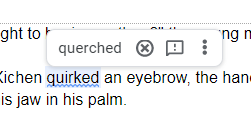
googledocs you are getting awfully uppity for something that can't differentiate between "its" and "it's" correctly
oho and now you're questioning my adverb usage? you? you?
you fucking dare?
you try to change 'tears' to 'years' for no reason but don't catch 'imporint'???
hey quick question gdocs
what the fuck
[ID: a screenshot of google docs suggesting "quirked" be switched to "querched" in the sentence fragment "Xichen quirked an eyebrow." End ID]
aficklemuse:
PSA! You're not "screwing over the man" by shitting on independent authors. You're just taking their livelihood. And we're not talking about KU books.
[Image ID: A screenshot of a tweet by username @KBrombergDriven. The text reads:
"½ Every time you return an ebook at Amazon, the author is charged back more than what they were paid for the sale. Yes, that means we could owe Amazon at the end of the month. Since TikToks went viral saying 'it's okay to return ebooks'
2/2 most authors returns have skyrocketed. Reading and returning a book is stealing. If you want free books, try the library app, Libby (among others) #AmazonisNotALibrary"
/.End ID]
Occasionally I'll see "shipping" in the credits of a TV show, and then have to remind myself that it's the department for mailing/transporting stuff and not what my brain tells me, which is that it is the department that looks into which of the characters have the best chemistry for romantic purposes.
kfbradshaw:
aritany:
from the studio that brought you "i swear i already revised this chapter", may i present: "is this scene actually dull or have i read it eleven billion times"
Don't forget the director's cut: "that word looks weird and not like a word anymore"







0 Response to "Tumblr Funny Pictures Eljiah and Christine"
Post a Comment